You Need More Money...
But You Cannot Afford To Lose The Money You Already Have.
Discover the 10-Point Opportunity Risk Check for evaluating investments, businesses, side hustles and online money-making offers before you commit your cash.
Someone has shown you another profitable-looking opportunity. The testimonials look convincing. The returns look attractive. And now you're wondering:
“Before I transfer my money, what exactly should I check?”
GET INSTANT ACCESS — ₦9,500Another Opportunity Has Landed In Your WhatsApp.
Maybe your friend sent it.
Maybe somebody added you to a Telegram group where people post payment screenshots every morning.
Maybe someone is telling you:
“You can earn 15% monthly.”
“People are already cashing out.”
“Only a few slots are left.”
“Don't overthink it.”
And because your salary is under pressure, your business needs additional income, or your family expenses keep growing, part of you desperately wants the opportunity to be genuine.
But another part of you remembers all the stories.
People who invested hundreds of thousands of naira and suddenly couldn't withdraw.
People who borrowed money to invest and ended up worse than when they started.
So now you're caught between two fears:
versus
“What if I don't invest and miss a genuine opportunity?”
You don't need to become afraid of every opportunity.
You need a better way to evaluate one before money leaves your account.
Here's What Nobody Told You About Risky Money Decisions
The problem isn't simply greed.
Intelligent people make bad financial decisions too.
Professionals do it. Business owners do it. Educated people do it.
One reason is surprisingly simple:
Imagine two people looking at exactly the same offer.
One has ₦20 million in savings.
The other has ₦400,000 saved, school fees approaching, rent to pay and a salary that barely survives the month.
Both see:
“Invest ₦300,000 and earn 15% monthly.”
The first person may see an investment.
The second person may see an escape.
And once an opportunity begins to represent relief, your brain can begin searching for reasons to believe.
Then Social Proof Appears
Your friend says he has withdrawn twice. You see screenshots. There are thousands of people in the group.
Suddenly it feels safer.
A screenshot may show that somebody received money. It does not automatically explain where the money came from, whether the business model is sustainable, or whether your own capital is appropriately protected.
Then FOMO Appears
“Registration closes tonight.”
“Only 15 slots remaining.”
“Price increases tomorrow.”
Your question changes from:
to:
The Greater The Pressure To Decide Quickly, The Greater Your Need To Slow The Decision Down.
My Name Is Dayo. And This Is Where Everything Changed.
My name is Dayo.
I am 39 years old, married, a father, and I live in Lagos.
For a long time, financial pressure sat quietly behind almost every important decision I made.
I had a professional job.
From the outside, things looked fine.
But people couldn't see what happened after salary entered my account.
Food. School expenses. Transport. Electricity. Family responsibilities. Unexpected bills.
Before long, another month had started.
I didn't necessarily want luxury.
I wanted breathing space.
I wanted another source of income so that every unexpected expense wouldn't feel like a financial emergency.
And that desire made opportunities incredibly attractive.
Then One Friday Evening In Ikeja...
A friend of mine—let's call him Femi—called me.
“Dayo, where you dey?”
“I'm still around Ikeja.”
“Come meet me. There's something I want to show you.”
We met at a small restaurant. After talking for a while, Femi brought out his phone.
“Guy, see this.”
The website looked professional. Charts. Investment packages. Testimonials. Photographs of businesses.
Femi had already invested.
“You've received money?” I asked.
He smiled.
“Twice.”
Then he showed me the payments.
Immediately, something shifted in my mind.
It was no longer an unknown opportunity. Somebody I trusted had received money.
“What exactly do they do with the money?” I asked.
“They invest it.”
“In what?”
“Agriculture, forex... different businesses.”
“How do those businesses generate enough money to pay the returns?”
Femi laughed.
“Dayo, sometimes you ask too many questions. Sometimes you just have to take risk.”
He wasn't entirely wrong. Every meaningful business or investment decision involves risk.
But later I discovered there is a huge difference between taking a calculated risk and taking a risk you haven't understood.
Failed Method #1 — Google Everything
I searched the company online. Their website appeared. Their social pages appeared. Positive comments. Negative comments.
One person called it legitimate. Another called it a scam.
An hour later, I had more information but almost no additional clarity.
Failed Method #2 — Ask More People
I called someone else.
“Have you heard about this?”
“Yes. My cousin is doing it.”
“Is it safe?”
“He has been getting paid.”
Again, I was hearing about payments—not how the underlying business worked.
Failed Method #3 — Trust The Testimonials
The WhatsApp group was full of them.
“Payment received!”
“God bless management!”
“I doubted at first!”
The more I looked, the safer it felt.
Then I asked myself:
It might prove someone received money. It doesn't necessarily explain where the money originated. It doesn't prove future payments. It doesn't prove sustainability.
Failed Method #4 — Start Small
I considered putting in a small amount first.
“If ₦50,000 works, then I can increase it.”
It sounded sensible.
But what if those early payments increased my confidence without reducing the actual long-term risk?
Early success can sometimes reduce caution.
Failed Method #5 — Follow Successful People
If an influential person joined something, I assumed they knew what they were doing.
Then the obvious occurred to me.
Successful people make mistakes too.
Educated people can misunderstand risks. Influential people may know less about an opportunity than you assume.
Then My Wife Asked One Question
One evening my wife asked:
“How much do you want to put into this thing?”
“I'm not sure.”
Then she asked:
I became defensive.
“Why are you already assuming we'll lose?”
She looked at me calmly.
“I'm not. I'm asking what happens if we do.”
Silence.
That was the question I had avoided.
I had calculated profit repeatedly.
I had barely calculated failure.
The Turning Point
A few days later, I discussed the opportunity with an older friend who understood business risk.
He asked:
“Where does their money come from?”
“Agriculture, trading, forex...”
He stopped me.
“That's what they told you. Explain how your money enters the business and how enough economic value gets created to pay the promised returns.”
I couldn't.
“Who controls the money?”
I wasn't sure.
“What happens if the underlying business performs badly?”
I didn't know.
“What have you independently verified?”
Not much.
That sentence changed the question.
I stopped asking, “Is this a scam?”
And started asking:
The System Was Born
I took out a notebook and wrote down every question I wished I had asked from the beginning.
What exactly is being promised?
Where do the returns come from?
Who is behind the opportunity?
What can I independently verify?
Why am I being rushed?
What are the withdrawal conditions?
Does the model depend heavily on recruitment?
What could I lose?
Can I afford that loss?
And finally:
Those questions gradually became a repeatable framework.
The 10-Point Opportunity Risk Check.
Not a tool for predicting the future.
A tool for exposing what you know, what you don't know, and what still needs investigation.
What 21 Days Of Practising The System Can Look Like
This is not a promise that your finances will transform in 21 days. It is a practical timeline for building stronger decision habits.
You Stop
You learn to create distance between the offer and the decision. “Pay today” no longer automatically means “decide today.”
You Ask Different Questions
You stop asking only about returns and start asking where the returns come from, what could go wrong and what evidence exists.
You Start Verifying
You learn to separate “they said” from “I independently verified.”
You Score The Opportunity
The Opportunity Risk Scorecard helps you see unanswered questions and warning signs instead of relying only on feelings.
You Think Differently
Before you think about how much you can make, you first understand what you could lose and what you still need to verify.
What Readers Could Say
“Honestly, na the Risk Scorecard open my eyes. Before, once person show me screenshots I go begin calculate profit. Now I first check wetin I know and wetin I never verify.”
“The biggest lesson for me was that a good person can still introduce you to a bad opportunity without knowing. Trust and due diligence no be the same thing.”
“The Pressure Check really helped me understand urgency. Before I for rush because person say slot dey finish. Now I first ask questions.”
“This no be one of those books promising millions. The 15 Questions Before You Pay is practical and straight to the point.”
“I used the framework on one small business proposal and realised say I never even ask what happens if sales no reach target. Sometimes na simple questions we dey miss.”
Introducing
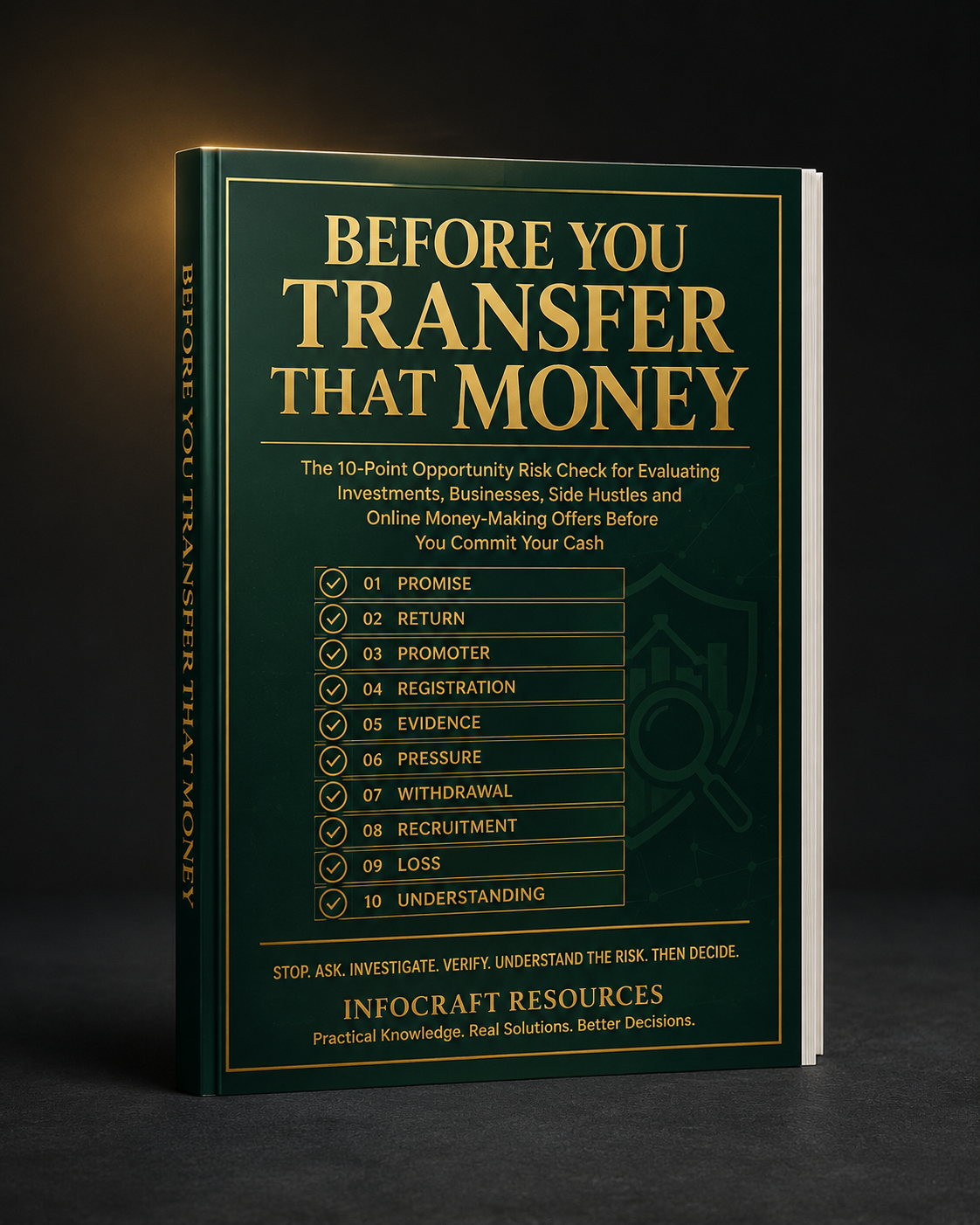
BEFORE YOU TRANSFER THAT MONEY
The 10-Point Opportunity Risk Check for Evaluating Investments, Businesses, Side Hustles and Online Money-Making Offers Before You Commit Your Cash.
Why Smart People Still Make Bad Money Decisions
Understand how financial pressure can influence the way you interpret potential rewards and risks.
The Desperation Trap
Discover why desperately needing an opportunity to work can change the questions you ask.
FOMO, Urgency & Limited Slots
Learn how deadlines and scarcity can affect calm decision-making.
Testimonials Are Not Due Diligence
Learn what screenshots, payments and personal recommendations can—and cannot—prove.
The 10-Point Opportunity Risk Check
Evaluate the promise, return, promoter, registration claims, evidence, pressure, withdrawals, recruitment dependency, potential loss and your own understanding.
Facts, Claims & Assumptions
Learn to separate what you have verified from what you have simply been told.
Your Personal Risk Boundary
Understand why the same opportunity can represent completely different levels of risk for two people.
When To Slow Down Or Walk Away
Identify situations requiring further research, qualified professional advice or a decision not to proceed.
Practical Case Studies
Work through fictional examples involving investments, business partnerships, side hustles and high-return offers.
You Also Get These Two Practical Bonuses
BONUS #1 — 15 Questions Before You Pay
Get 15 practical questions you can use when talking with someone promoting an investment, business or money-making opportunity.
Use them before a phone call, meeting or transfer to uncover information about the business model, returns, withdrawals, risks and supporting evidence.
BONUS #2 — Opportunity Risk Scorecard
Stop relying only on “I have a good feeling about this.”
The scorecard helps you organise what you know, identify unanswered questions and highlight issues that need further verification.
Everything You Receive Today
Original product price: ₦15,500
GET INSTANT ACCESS FOR ₦9,500Introductory Price
The ₦9,500 introductory price applies to the first 50 completed sales only.
After sale number 50, the price increases to ₦15,500.
Only publish this statement if you genuinely track the sales and increase the price after the 50th completed purchase.
DAYS
Your 30-Day Money-Back Guarantee
I don't want you buying because somebody pressured you.
That would go against everything this product teaches.
Read BEFORE YOU TRANSFER THAT MONEY. Use the worksheets. Apply the framework to an opportunity.
If you genuinely believe the system did not give you a clearer process for asking questions, examining claims and evaluating risk, request a refund within 30 days according to the refund procedure provided at checkout.
No honest checklist can promise that you'll never lose money.
This guarantee is about whether the educational framework itself gives you a clearer decision process.
GET THE SYSTEM — ₦9,500You Have Two Options
P.S.
You have a 30-day money-back guarantee. Read the guide, use the framework and decide whether it genuinely gives you a clearer process for evaluating opportunities.
P.P.S.
The introductory price is ₦9,500 for the first 50 completed sales. If this is your real launch policy, the price moves to ₦15,500 after sale number 50.
P.P.P.S.
You don't need to become afraid of opportunities.
You simply need to stop taking important risks without understanding what you're saying YES to.
Before you transfer that money, ask the questions first.
GET INSTANT ACCESS — ₦9,500BEFORE YOU TRANSFER THAT MONEY is provided for general educational and informational purposes only.
It does not constitute personalised financial, investment, accounting, legal or tax advice.
No checklist, scorecard or evaluation framework can guarantee that an opportunity is legitimate, profitable or free from risk.
Investments and business activities may result in financial loss, including loss of capital.
Where appropriate, independently verify licensing, registration and regulatory claims with the relevant authorities and seek advice from appropriately qualified professionals before making significant financial decisions.