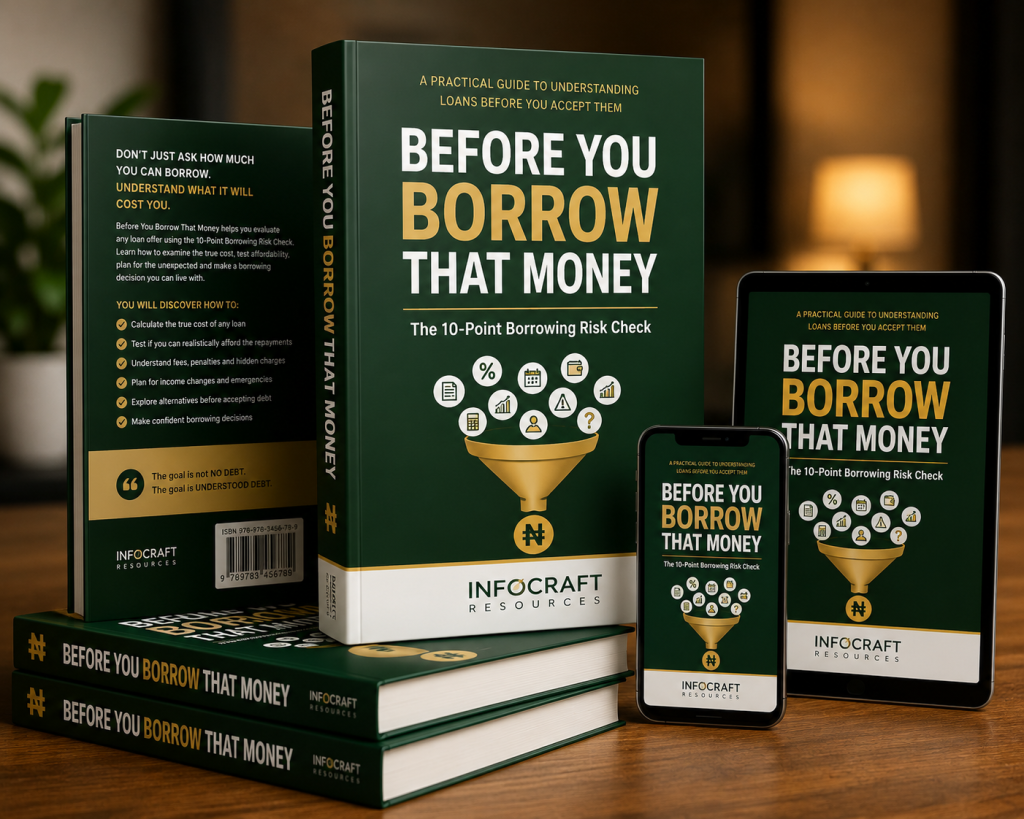
Before You Borrow That Money
A practical borrowing decision guide for understanding what a loan will really require from you before you accept it.
Before you accept a personal loan, salary advance, loan-app offer, cooperative loan or business loan, learn how to examine the true cost, repayment pressure and potential consequences.
GET INSTANT ACCESS FOR ₦9,700 Instant PDF Download
BEFORE YOU
BORROW THAT
MONEY
The 10-Point Borrowing Risk Check
But What Will the Loan Do to Your Tomorrow?
Maybe the need is urgent.
Rent is approaching. School fees are waiting. Your business needs stock. An unexpected expense has appeared. Or the money available this month simply cannot cover everything demanding attention.
Then you see an offer.
For a moment, you feel relief.
You begin thinking about everything the money could solve.
But there is another question sitting quietly in the background:
The lender tells you how much you can receive.
But have you calculated exactly how much you will repay?
You know the monthly instalment.
But have you considered what will remain from your income after that instalment leaves your account?
What happens if your income arrives late, business slows down, or another unexpected expense appears?
That is the decision Before You Borrow That Money was created to help you examine.
The Immediate Problem Can Become Louder Than the Future Obligation
When money is urgently needed, attention naturally moves towards solving the immediate problem.
If ₦300,000 could solve something causing serious pressure today, your mind naturally starts asking:
“How quickly can I get it?”
“Will they approve me?”
“How much can they give me?”
Those are understandable questions.
But other questions can quietly move into the background.
THE RELIEF
The money arrives now.
THE REPAYMENT
Your future income carries the obligation.
The Relief-Repayment Gap
The relief is immediate.
The repayment is future.
And because the relief arrives first, it can feel more important at the moment the borrowing decision is made.
The system does not tell you that borrowing is always wrong.
It helps you investigate whether a particular debt makes sense for your circumstances before you accept it.
The 10-Point Borrowing Risk Check
Instead of starting with “How much can I borrow?”, start with “Does this debt actually make sense?”
Why exactly am I borrowing?
How much will leave my pocket from beginning to end?
Can my actual income realistically support the repayment?
What remains after every repayment?
Do I understand what I am agreeing to?
What additional charges could apply?
What happens if income falls or arrives late?
What financial obligations am I already carrying?
Is borrowing really the best available option?
What happens if things do not go according to plan?
Let Me Tell You About Tunde
Tunde is 42, married, and lives with his family in Lagos.
For years, he thought he understood borrowing.
He wasn't reckless.
He worked, paid bills, looked after his family, and tried to build a small business alongside his regular work.
Like many households, some months were comfortable.
Other months were mathematics.
Rent. School expenses. Food. Transport. Electricity. Family responsibilities. Business expenses.
Something always seemed to be waiting.
Then came a period when several expenses arrived almost together.
His business needed working capital.
Household expenses needed attention.
Another major payment was approaching.
Borrowing appeared to offer the quickest solution.
That thought brought immediate relief.
He checked how much was available.
He checked how quickly the money could arrive.
Then he looked at the monthly repayment.
And he thought:
Notice the words:
Should be able to.
He had not written down every existing obligation.
He had not calculated what would remain after repayment.
He had not tested the decision against a bad month.
He was concentrating on the money coming in, not everything that would have to go out afterwards.
He Compared Lenders by How Much They Would Give Him
One offered less.
Another offered more.
Naturally, the larger amount looked more attractive.
But he wasn't comparing the complete obligations.
He was comparing access to money.
He Focused on the Monthly Repayment
If the instalment looked manageable, he felt comfortable.
But “manageable” existed mostly in his head.
A repayment does not exist alone.
It lives beside food, rent, transport, school expenses, existing debt, business costs, savings, emergencies and every other demand placed on income.
He Assumed Future Income Would Cover Everything
He evaluated the debt using a normal month.
But what if a client delayed payment?
What if business slowed?
What if another expense appeared?
He had evaluated the debt using the month he hoped to have, not necessarily the month he might experience.
He Assumed Business Borrowing Was Automatically Productive
“At least this money is going into business,” he told himself.
But using debt for business does not guarantee that the business will generate enough additional cash, quickly enough, to service the obligation.
Then One Conversation Changed the Questions
One afternoon, Tunde met an old friend named Kunle around Ikeja.
Kunle had spent years working in banking.
Tunde explained the loan.
He explained how much was available and how quickly he could get it.
Kunle listened.
Then he asked:
Tunde repeated the monthly instalment.
Kunle shook his head.
Tunde did not have the answer immediately.
Then Kunle asked:
Again, Tunde did not know exactly.
Then came the question that stayed with him:
That distinction changed everything.
The lender decides whether to lend.
You still have to decide whether to borrow.
Tunde went home and began writing questions.
Four questions became six.
Six became ten.
Those questions eventually became the 10-Point Borrowing Risk Check.
The framework does not decide for you.
It does not predict the future.
It does not guarantee that a loan will work out perfectly.
It simply helps bring the questions that urgency can push into the background back into the centre of your decision.
Your 21-Day Decision-Making Journey
This is not a promise that your finances will transform in 21 days. It shows how you can begin applying a more structured borrowing habit.
Stop Asking Only “How Much Can I Get?”
Separate loan approval from loan affordability.
Calculate the Real Cost
Look beyond the advertised instalment to repayment, fees and other known charges.
Test Your Cash Flow
Put the proposed repayment beside your actual monthly commitments.
Run the Bad-Month Test
Ask what happens if income falls, business slows or another expense appears.
Examine Alternatives
Consider whether the expense could be reduced, delayed, negotiated or funded differently.
Use the Full 10-Point Check
Choose among three legitimate answers: YES, NO, or I DON'T KNOW ENOUGH YET.
BEFORE YOU BORROW THAT MONEY
A practical guide for understanding debt before you accept it.
Before You Accept the Money
Why the real borrowing decision begins before approval.
The Relief-Repayment Gap
Understand why immediate financial relief can overshadow future repayment pressure.
Why “I Can Manage It” Is Not a Calculation
Turn assumptions about affordability into actual numbers.
Why Are You Borrowing?
Examine emergencies, consumption, business needs and temporary cash-flow gaps.
The True Cost of Borrowing
Look beyond the amount received and examine the wider obligation.
The Cash-Flow Test
Calculate what remains after repayment.
The Bad-Month Test
Stress-test the decision against income disruption and unexpected expenses.
The 10-Point Borrowing Risk Check
Work through Purpose, True Cost, Affordability, Cash Flow, Terms, Fees, Income Risk, Existing Debt, Alternatives and Worst Case.
The Three Possible Decisions
YES. NO. I DON'T KNOW ENOUGH YET.
Your Personal Borrowing Decision Worksheet
Bring everything together before making your decision.
Two Practical Resources Included
BONUS #1
Loan True-Cost Calculator Worksheet
A practical worksheet for recording the amount received, repayment amounts, known fees and total repayment obligation.
It helps move the decision away from “the instalment doesn't look too bad” towards numbers you can actually examine.
BONUS #2
15 Questions to Ask Before Accepting a Loan
A quick-reference checklist you can keep on your phone and use when evaluating a personal loan, loan app, salary advance, cooperative loan or business borrowing opportunity.
Questions cover repayment, charges, affordability, penalties, income risk and alternatives.
Understand Before You Owe
Regular Price: ₦19,500
Introductory Price
🔒 Secure Checkout • ⚡ Instant Download • 🛡 30-Day Guarantee
Introductory Pricing
The ₦9,700 introductory price applies to the first 50 sales. After that allocation is reached, the price may return to ₦19,500.
The 30-Day “Read It and Decide” Guarantee
Download Before You Borrow That Money.
Read it. Work through the 10-Point Borrowing Risk Check. Use the worksheets.
If within 30 days you decide that the guide has not provided the practical borrowing decision framework described on this page, contact us according to the refund terms provided at checkout.
The guide cannot guarantee a particular financial outcome. What we stand behind is the educational framework you are purchasing.
GET INSTANT ACCESS FOR ₦9,700You Have Two Options
OPTION 1: Close This Page
Nothing dramatic happens.
The next time money is urgently needed, you can examine the available loan the way you always have.
Check how much you can receive.
Look at the monthly instalment.
Decide whether it “looks manageable.”
Then deal with the repayment afterwards.
Maybe everything works perfectly.
Maybe it doesn't.
The issue is not that borrowing automatically produces a bad outcome. The issue is making an important financial decision without a consistent process for evaluating it.
OPTION 2: Build the Process Before You Need It
Learn the framework.
Calculate true cost.
Test affordability.
Examine cash flow.
Read the terms.
Identify fees.
Stress-test your income.
Consider existing debt and alternatives.
Examine the worst case.
Then when another loan offer appears, you have a process for examining it.
The objective is not necessarily to stop borrowing.
It is to stop treating access to money as the same thing as affordability.
UNDERSTAND BEFORE YOU OWE.
GET BEFORE YOU BORROW THAT MONEY ₦9,700 • Instant AccessThree Final Thoughts
P.S. You have 30 days to read the guide and determine whether the framework delivers what has been described. If it doesn't, use the money-back guarantee according to the refund terms.
P.P.S. The introductory price is ₦9,700 for the first 50 sales. After that, the price may return to ₦19,500.
P.P.P.S. The question is not simply whether someone is willing to lend you money. Before accepting it, ask the question that matters to your own finances: