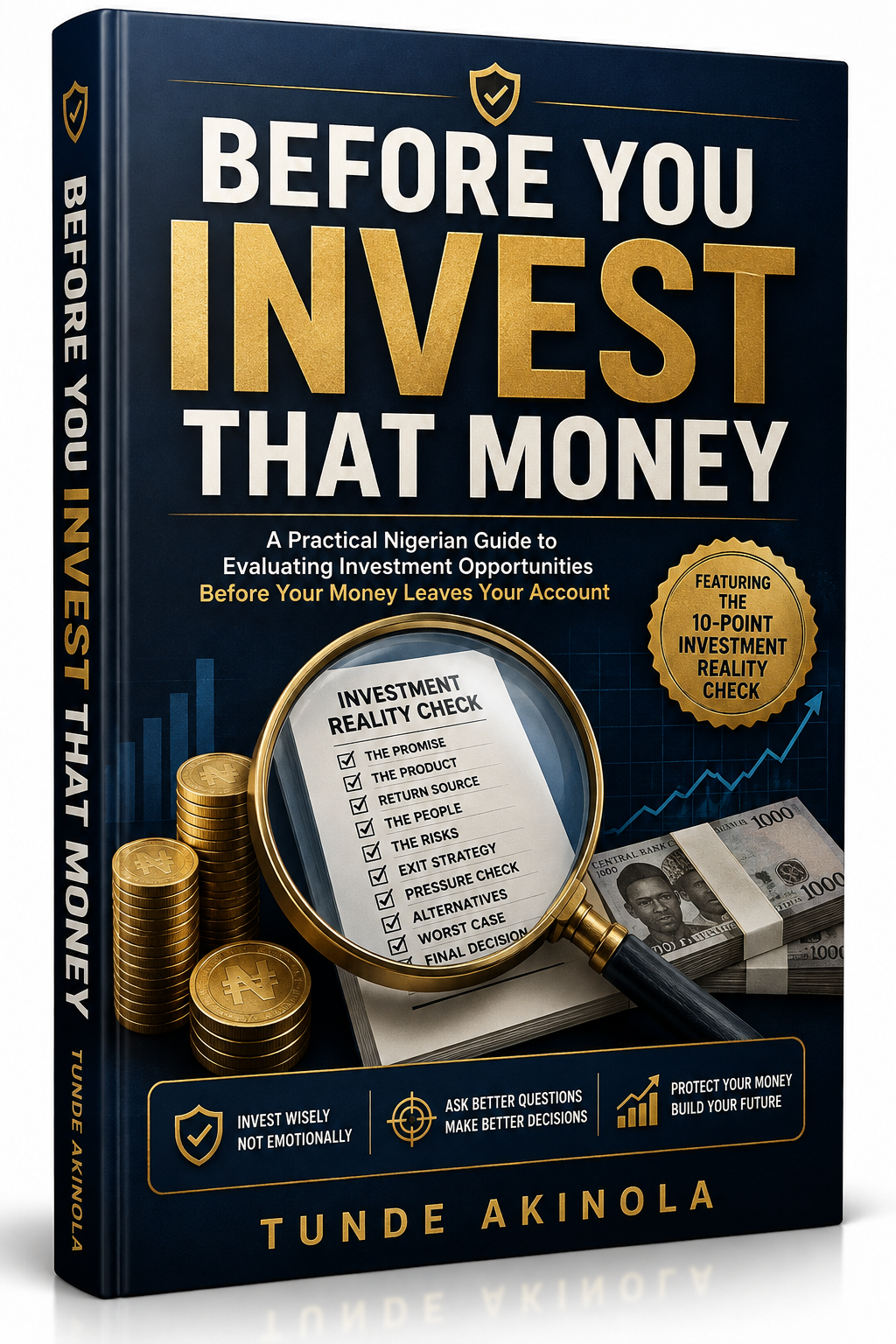
Before You Invest That Money
A practical Nigerian guide to evaluating investment opportunities before your money leaves your account.
Learn how to examine the promise, understand what you are buying, investigate where returns come from, test the risks, verify claims, understand your exit and decide whether you know enough before committing your money.
GET INSTANT ACCESS FOR ₦9,800 Secure Checkout • Instant Digital Download
BEFORE YOU
INVEST
THAT MONEY
A Practical Nigerian Guide to Evaluating Investment Opportunities Before Your Money Leaves Your Account
Maybe someone sends you a message.
"Guy, you need to see this."
A friend adds you to a WhatsApp group.
A colleague tells you about an investment supposedly paying people every week.
Your cousin sends screenshots.
Someone you respect has already invested.
The presentation looks convincing. The website looks professional. There is a physical office. People are posting withdrawals.
And suddenly you start calculating.
Maybe school fees become easier.
Maybe you increase your business capital.
Maybe you finally stop depending entirely on salary.
Maybe this is the opportunity you have been waiting for.
And before long, the question changes from:
to:
This guide helps you slow that moment down.
Not to tell you never to invest.
Not to tell you every opportunity is fraudulent.
But to help you understand what you know, what you have merely been told, and what you still need to verify.
The Evidence-Excitement Gap
The problem may begin when you become emotionally committed to an opportunity before you have independently verified enough about it.
Investment opportunities rarely arrive as neutral information.
They arrive with stories.
"People are making serious money."
"My friend has withdrawn three times."
"This is still early."
"Don't miss this."
"The company is registered."
"They have an office."
Each claim may deserve investigation.
But none should replace investigation.
What exactly is being promised?
What are you actually buying, owning or funding?
What economic activity is expected to generate the return?
Who controls the organisation and investor funds?
What claims can you independently verify?
How could you lose money?
How and when can you get your money out?
Would you still want it without urgency, testimonials and FOMO?
What else could you do with the same money?
If the investment fails, what happens to your finances?
The Opportunity That Changed the Questions
Tunde is 41 and lives in Lagos.
He works in technology and has spent years around business owners, professionals and people constantly searching for ways to grow their money.
For years, one thought stayed with him:
That thought was not the problem.
The problem was what happened whenever an exciting opportunity appeared.
It Usually Started With Someone He Trusted
One Saturday afternoon, his friend Kunle called.
There was a company.
There was a website.
There were packages.
There were projected returns.
And most importantly, Kunle had received money.
He sent screenshots.
Tunde's question changed immediately.
Instead of:
he began asking:
Method 1: Start Small
Tunde thought starting with a small amount was enough to test an investment.
Sometimes the first payment arrived.
The mistake was treating one successful payment as proof of the entire model.
A payment proves that a payment occurred.
It does not automatically prove that the underlying structure is sustainable.
Method 2: People Are Withdrawing
WhatsApp screenshots looked convincing.
After seeing enough of them, hesitation started to feel foolish.
Later, Tunde learned to ask:
Method 3: The Company Is Registered
Registration felt reassuring.
But a company's existence and the safety or suitability of a particular investment product are different questions.
Tunde began asking:
Method 4: They Have an Office
An office looked solid.
But eventually he wrote:
Method 5: Someone I Respect Is Involved
Sometimes an opportunity came through someone Tunde respected.
That created another shortcut:
But Tunde did not actually know what the other person had checked.
The Conversation That Changed Everything
One day, Tunde discussed another opportunity with an older friend named Chike in Abuja.
Tunde spent several minutes explaining the potential returns.
Chike listened.
Then asked:
Tunde answered.
Then stopped.
Most of his answer came directly from the promoter.
Chike asked:
Silence.
Tunde did not know.
Again, unclear.
Then Chike said:
That was the turning point.
KNOWN. TOLD. UNKNOWN.
That evening Tunde opened a notebook.
He wrote:
Under KNOWN, he wrote facts he could establish.
Under TOLD, he wrote claims from promoters and friends.
Under UNKNOWN, he wrote everything important he still could not answer.
- Where exactly do returns come from?
- What economic activity generates them?
- Who controls investor funds?
- What happens if withdrawals increase?
- How can the investment be exited?
- What happens if the amount is lost?
Suddenly, the opportunity looked different.
Not necessarily bad.
Just less certain.
The Rules He Built
Those rules became the foundation for the 10-Point Investment Reality Check.
Practise Better Questions Before You Commit Money
This is a structured learning schedule, not a scientific promise that a permanent habit forms in exactly 21 days.
Stop Looking at Returns First
Take one opportunity and separate KNOWN, TOLD and UNKNOWN.
Identify Your Trigger
Recognise whether urgency, testimonials, FOMO or financial pressure is influencing you.
Investigate the Return Source
Ask what economic activity is expected to create the return.
Check the People and Claims
Verify names, company information, documents and regulatory claims.
Examine Risk Before Reward
Write down realistic ways the investment could lose value or become inaccessible.
Test Liquidity
Find out how and when you can exit and what restrictions apply.
Remove Social Proof
Ask whether the underlying opportunity still makes sense without testimonials and withdrawal screenshots.
Run the Worst-Case Test
Examine what would happen if the money became unavailable or was lost.
Make the Decision
Choose YES, NO, or I DON'T KNOW ENOUGH YET.
What Readers May Recognise in the Framework
These are example review formats only. Replace them with genuine customer feedback before presenting them as verified testimonials.
"The KNOWN, TOLD and UNKNOWN exercise na the part that really got me. I realised almost everything I knew about one opportunity came from the person selling it."
"My biggest problem was FOMO. Once people start posting withdrawals, I dey feel like say I am the only person missing out. The Pressure Check helped me slow down."
"I like that the book no dey shout scam at everything. It just helps you ask better questions before you commit."
"The Worst-Case Check made me realise I was planning to use money already meant for something important because I expected to replace it quickly."
"'I don't know enough yet' became my favourite line. Before, once person say offer dey expire, I dey feel pressure to decide quickly."
BEFORE YOU INVEST THAT MONEY
A practical investment decision guide designed to help you examine opportunities before committing your money.
Before Your Money Leaves Your Account
Understand why investment decisions can become emotional before investigation even begins.
The Promise Check
Separate promotional language from what is actually being promised.
The Product Check
Identify what you are actually buying, owning, lending to or funding.
The Return-Source Check
Investigate where returns are expected to come from.
The People and Company Check
Examine the people, company information and independently verifiable activity.
The Regulation and Documentation Check
Understand what registration and regulatory claims can and cannot establish.
The Risk Check
Identify the downside before becoming attached to the upside.
The Liquidity and Exit Check
Understand how your money comes out, when it can come out and what may restrict exit.
The Pressure Check
Test urgency, scarcity, testimonials, social proof and FOMO.
The Alternatives Check
Compare the investment against other uses of the same money.
The Worst-Case Check
Stress-test the opportunity against your real financial life.
The Complete 10-Point Investment Reality Check
Bring all ten investigations into one structured decision.
The 21-Day Investment Decision Habit
Practise the framework until better questions become easier to ask.
Understand Before You Invest
Create permanent investment boundaries for future opportunities.
Two Practical Resources Included
BONUS #1
Investment Opportunity Question Sheet
A ready-to-use question sheet for investment presentations, WhatsApp conversations, Zoom calls and physical meetings.
It helps you ask about the product, return source, control of funds, risks, fees, exit, documentation and the information that still needs verification.
BONUS #2
"Let Me Check First" Investment Scripts
Simple language for slowing down an investment conversation without accusing anyone or getting drawn into unnecessary arguments.
Useful when someone says: "You need to pay today," "Everybody is entering," or "I have already withdrawn."
Build a Decision Process Before the Next Opportunity Arrives
Regular Price: ₦19,500
Current Launch Price
Secure Checkout • Instant Digital Access • Private Purchase
Launch Pricing
The ₦9,800 launch price is intended for the first 50 completed purchases. Use this statement only if the limit is genuinely tracked and enforced.
14-Day Satisfaction Guarantee
Download the guide. Read it. Use the 10-Point Investment Reality Check on at least one opportunity.
If within 14 days you genuinely believe the guide did not give you a clearer framework for evaluating investment opportunities, contact us according to the refund terms supplied at checkout.
Eligible refund requests will be handled according to those terms.
This guarantee relates to satisfaction with the educational product. It does not guarantee investment profits, prevent investment losses or promise that the framework can identify every fraudulent or unsuccessful opportunity.
GET INSTANT ACCESS FOR ₦9,800You Have Two Options
OPTION 1: Close This Page
Nothing dramatic happens.
The next opportunity arrives.
Someone sends screenshots.
Someone tells you they are withdrawing.
You calculate returns.
You search the company name.
You ask a few friends.
Then perhaps you say:
Maybe it works. Maybe it does not.
But the decision process remains unchanged.
OPTION 2: Build Your Process Now
Understand the promise.
Identify the product.
Trace the return source.
Verify the people and company.
Check documents and regulatory claims.
Identify risk.
Understand your exit.
Remove social pressure.
Compare alternatives.
Stress-test the downside.
Then choose:
CLARITY BEFORE COMMITMENT.
GET BEFORE YOU INVEST THAT MONEY ₦9,800 • Instant Digital AccessThree Final Thoughts
P.S. You have 14 days under the stated satisfaction guarantee to read the guide, use the framework and decide whether it delivered useful educational value, subject to the checkout terms.
P.P.S. The current ₦9,800 launch price is intended for the first 50 completed purchases. Only use this limit publicly if you genuinely track and enforce it.
P.P.P.S. The next opportunity may be excellent. It may be terrible. Or it may simply be something you do not understand well enough yet. The purpose of this guide is to help you separate confidence from evidence before your money leaves your account.
Important Financial Disclaimer
Before You Invest That Money is an educational resource designed to help readers ask structured questions when evaluating investment opportunities.
It does not constitute personalised financial, investment, legal, tax or regulatory advice, and it does not recommend any particular investment, company, asset class or financial product.
All investments involve risk. Investment values may rise or fall, access to funds may be restricted, and you may lose some or all of the money committed depending on the investment and circumstances.
Where substantial money, complex products or regulated investments are involved, consider consulting an appropriately qualified and regulated professional and independently verifying relevant information before making a financial commitment.
InfoCraft Resources does not guarantee profits, prevent losses, identify every fraudulent opportunity or guarantee that following the framework will produce a particular financial outcome.