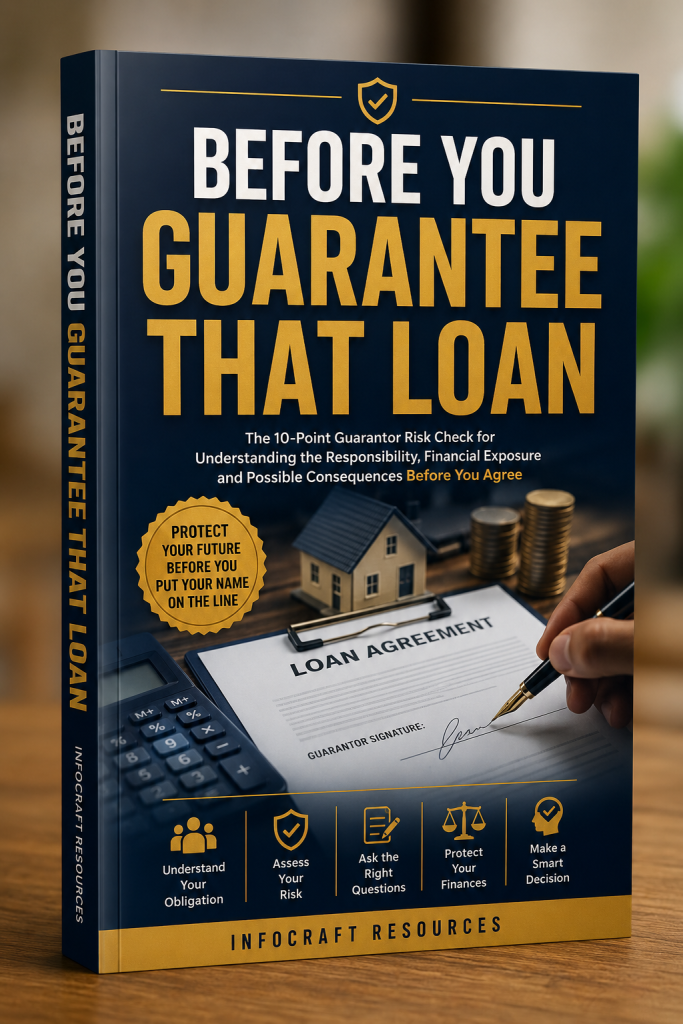
Before You Guarantee That Loan
A practical decision guide for understanding the responsibility, financial exposure and possible consequences before you agree to guarantee someone else's debt.
Before you sign for a friend, relative, colleague, employee or business associate, learn how to examine the obligation itself, identify what is still unknown, and decide whether the risk makes sense for you.
GET INSTANT ACCESS FOR ₦9,800 Secure Checkout • Instant Digital Access
BEFORE YOU
GUARANTEE
THAT LOAN
The 10-Point Guarantor Risk Check
Maybe it is your brother.
A close friend.
A colleague you have worked with for years.
Someone from your cooperative.
A business associate.
They are not asking you to give them the money. They only need you to "stand as guarantor."
And that sounds different. Perhaps less serious.
Or perhaps:
But somewhere underneath that confidence is another question:
That is the question this guide was created to help you investigate.
Not by telling you never to guarantee anybody's loan. Not by telling you whom to trust. And not by pretending anyone can predict whether a borrower will repay.
Instead, it gives you a structured process for examining the obligation before you put your name behind it.
The Trust-Obligation Gap
Most guarantor decisions begin with the relationship rather than the document.
"He's my brother."
"She's my friend."
"We've worked together for 12 years."
Those statements may tell you something about the relationship.
They do not automatically tell you:
- Exactly what you are guaranteeing
- How much could potentially be involved
- How long the obligation lasts
- What circumstances could trigger responsibility
- What recovery rights may apply
- What happens if the borrower loses income
- What effect the guarantee could have on your own finances
That is what we call the Trust-Obligation Gap.
It is a practical description used in this guide. It is not a scientific diagnosis.
Am I agreeing because I understand the obligation or because saying no feels difficult?
What exactly am I guaranteeing?
What could I potentially become responsible for?
Could my own finances withstand the consequence?
What evidence supports the borrower's repayment plan?
What does the actual document say?
What recovery, collateral or enforcement provisions matter?
When does my responsibility begin and end?
Could I help in another way?
What is the most serious realistic consequence for me?
The Signature That Looked So Simple
Imagine a man called Kunle.
Kunle is 48 and lives in Lagos.
He has known his friend Dele for nearly 17 years.
They attend the same church. Their wives know each other. Their children have met.
One Tuesday afternoon, Dele calls.
Dele explains that he is applying for a business loan. Everything is almost completed. There is only one remaining requirement.
A guarantor.
Kunle does not immediately see a problem.
After all, this is Dele.
He knows where Dele lives. He knows the business. He knows the family.
So his mind begins answering the wrong question:
His answer is yes.
But imagine that instead of signing immediately, Kunle asks:
There is silence.
Suddenly, asking questions feels like distrust.
When "No" Feels Personal
This is where many guarantor decisions become difficult.
Not necessarily because the document cannot be understood.
But because the relationship can make examining it feel uncomfortable.
Approach 1: "I Know Him"
Knowing someone's character may matter.
But it does not automatically explain how much you could be responsible for, how long the obligation lasts, or what the contract says happens after default.
Approach 2: "He Has a Good Job"
A stable job may be relevant.
But what other debts exist? What does the repayment require? What if employment changes?
Approach 3: "It's Just a Formality"
If your signature carries no significance, why is it required?
That does not mean something improper is happening. It means you should understand why the lender requires your commitment.
Approach 4: "The Amount Is Small"
A small loan amount may genuinely create less exposure than a large one.
But first determine what your agreement actually covers.
Approach 5: "I Don't Want to Offend Them"
This may be the most human reason of all.
Kunle wonders whether asking questions will make Dele think he is a bad friend.
Then he asks himself:
The Turning Point
The next morning, Kunle opens the document again.
He takes a notebook and creates three columns:
Under KNOWN:
- Loan amount
- Borrower's name
- Purpose
Under TOLD:
- "Business is doing well"
- "Repayment won't be a problem"
- "It is only a formality"
Then he reaches UNKNOWN.
- Exact guarantor responsibility
- Maximum potential exposure
- Duration
- What triggers responsibility
- What happens after missed payments
- Whether collateral is involved
- What happens if business slows down
- Whether he could personally withstand the consequence
For the first time, the real problem becomes visible.
Kunle does not necessarily have evidence that the loan is bad.
He simply realises:
That becomes the turning point.
Not yes. Not no.
Not yet.
The Sentence That Changes the Conversation
No accusation.
No prediction of failure.
Just a boundary.
That principle became the foundation of the 10-Point Guarantor Risk Check.
Turn Better Questions Into a Repeatable Habit
The 21-day structure is a learning schedule, not a scientific promise that a permanent habit forms in exactly 21 days.
Separate Person From Document
Ask whether you trust the person and whether you understand the guarantee. Answer separately.
Define the Obligation
Identify the loan amount, guarantor clause, duration and important conditions.
Run the Liability Check
Find out what the agreement says could happen if repayment stops.
Test Your Own Finances
Ask what the guarantee could mean for your household or business if responsibility reaches you.
Test Borrower Capacity
Examine what actual income is expected to service the loan and what happens in a weaker month.
Read the Document Again
Focus on liability, recovery, collateral, duration, release and default provisions.
Consider Alternatives
Ask whether there are other ways to help without accepting the same obligation.
Run the Worst-Case Check
Identify the most serious realistic downside and decide whether you are willing to accept it.
Make the Decision
Choose YES, NO, or I DON'T KNOW ENOUGH YET.
What Readers Could Say After Using the Framework
The examples below are placeholders only. Replace them with genuine customer feedback before presenting them as real testimonials.
"What stood out for me was separating trust from the obligation. Person fit be your close friend, but you still need to understand wetin you dey sign."
"I liked the UNKNOWN concept. Before, if I didn't understand something, I might just assume it was okay. Now I know say I fit ask another question."
"The relationship section hit differently. Sometimes na because we no wan offend person we dey agree quickly."
"The worst-case exercise no dey tell you say something bad must happen. It simply asks whether you understand what could happen."
"Simple English and practical worksheets. Trust the person if you choose, but understand the obligation before signing."
BEFORE YOU GUARANTEE THAT LOAN
The 10-Point Guarantor Risk Check for understanding the responsibility, financial exposure and possible consequences before you agree.
Before Your Signature Becomes an Obligation
Understand why a request that sounds simple deserves careful examination.
The Trust-Obligation Gap
Separate trust in the borrower from understanding the guarantee.
The Relationship Check
Identify whether guilt, loyalty or social pressure is influencing the decision.
The Obligation Check
Understand exactly what you are being asked to guarantee.
The Liability Check
Investigate the circumstances under which responsibility could reach you.
The Affordability Check
Ask whether your own finances could withstand the consequence.
The Borrower Capacity Check
Move beyond promises and examine the repayment assumptions.
The Terms Check
Identify important clauses and unanswered questions.
Recovery & Duration
Understand relevant recovery provisions and when your responsibility begins and ends.
The Alternatives Check
Explore other ways to help without automatically accepting the same obligation.
The Worst-Case Check
Understand the downside before deciding whether it is acceptable.
The Complete 10-Point Guarantor Risk Check
Bring the entire decision onto one structured scorecard.
The 21-Day Guarantor Decision Habit
Practise the system until better questions become easier to ask.
Understand Before You Sign
Create permanent personal rules for future guarantor requests.
Two Practical Resources Included
BONUS #1
Guarantor Agreement Question Sheet
A practical checklist of questions to use before discussing or signing a guarantee.
It helps you investigate responsibility, duration, potential liability, release conditions, missed repayments and information that should be obtained in writing.
BONUS #2
"Let Me Check First" Conversation Scripts
Practical language for slowing down a guarantor request without turning the conversation into an accusation.
Use scripts such as: "This isn't about whether I trust you. I have a personal rule that I don't sign financial obligations until I understand the terms properly."
Understand Before You Put Your Name Behind Someone Else's Debt
Regular Price: ₦19,500
Current Digital Price
Secure Checkout • Instant Digital Access • Private Purchase
Current Price
The current digital price is ₦9,800. Any future price change should be clearly communicated rather than supported with artificial countdowns or fake scarcity.
7-Day Product-Description Guarantee
Open the guide. Review the 10-Point Guarantor Risk Check. Use the worksheets.
If within seven days you believe the product is materially different from what was described on this page, contact InfoCraft Resources according to the published refund terms.
If your request qualifies under those terms, your purchase will be refunded.
This guarantee relates to the product matching its description. It does not guarantee a particular financial, legal or relationship outcome.
GET INSTANT ACCESS FOR ₦9,800You Have Two Options
OPTION 1: Close This Page
Nothing dramatic has to happen.
The next time somebody asks you to stand as guarantor, you can decide the way you always have.
Think about the relationship.
Decide whether you trust them.
Perhaps everything works perfectly.
But you may still be left wondering:
OPTION 2: Build a Process Before the Next Request
Learn the ten checks.
Understand the document.
Identify your potential exposure.
Examine the borrower's repayment assumptions.
Consider your own financial capacity.
Review alternatives.
Understand the realistic downside.
Then when someone asks:
your first reaction can become:
CLARITY BEFORE COMMITMENT.
GET BEFORE YOU GUARANTEE THAT LOAN ₦9,800 • Instant Digital AccessThree Final Thoughts
P.S. You have seven days under the stated product-description guarantee to examine the guide and confirm that it delivers the framework described here, subject to the published refund terms.
P.P.S. The current price is ₦9,800. If the price changes later, the new price should be communicated clearly rather than through artificial urgency.
P.P.P.S. The person asking you to guarantee their loan may genuinely be someone you love, respect and trust. That is precisely why the decision deserves to be handled carefully.
Important Financial and Legal Disclaimer
Before You Guarantee That Loan is an educational resource and does not constitute personalised financial, credit or legal advice.
Guarantee agreements can differ significantly, and the legal consequences of signing depend on the wording of the particular agreement, applicable law, lender, type of credit and individual circumstances.
Where an agreement involves substantial money, property, collateral, unclear clauses or consequences you do not understand, consider obtaining advice from an appropriately qualified Nigerian legal or financial professional before signing.
InfoCraft Resources does not guarantee that using the framework will prevent financial loss, relationship problems, enforcement action or any other particular outcome.